

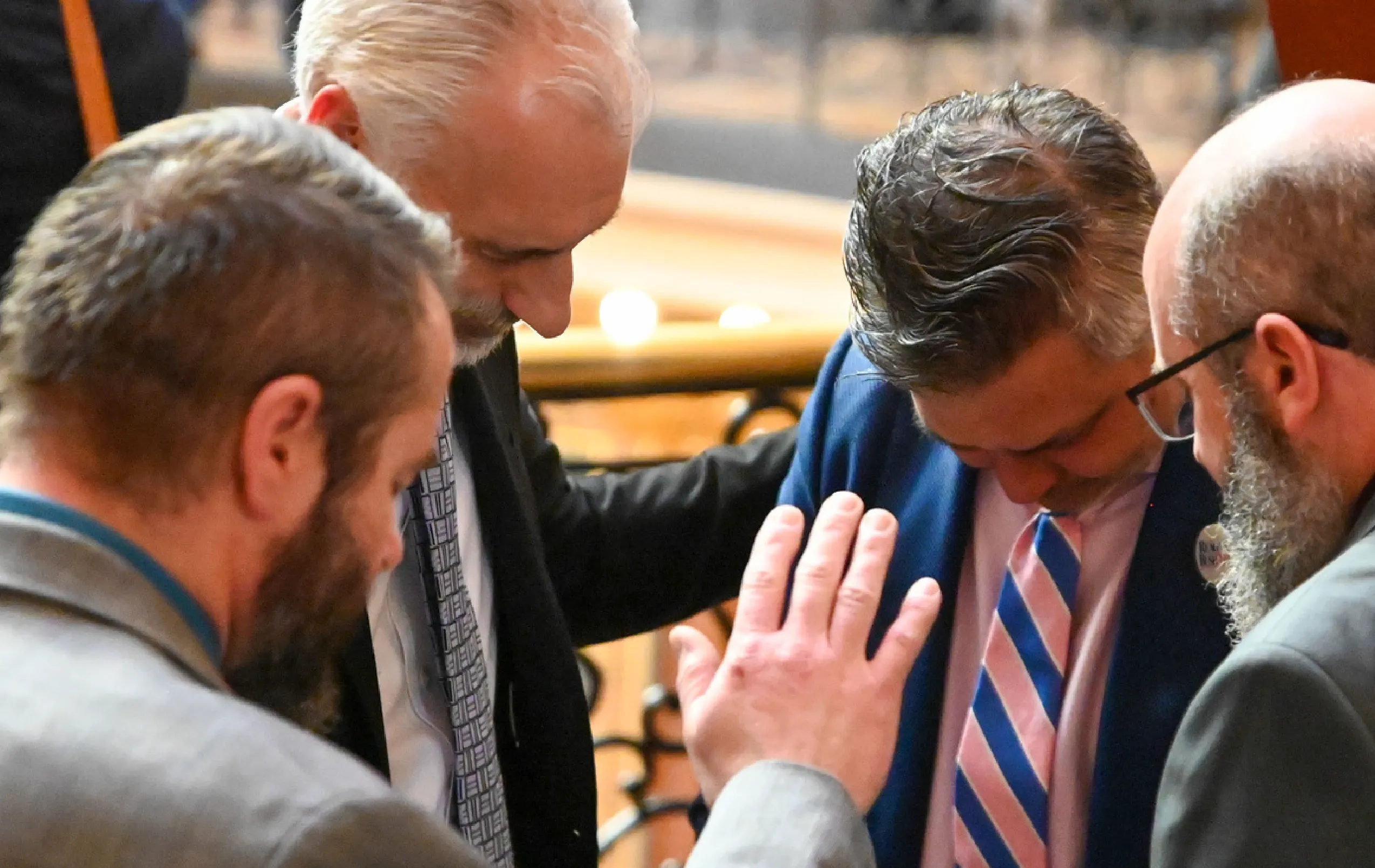
On June 9th, the Church Ambassador Network hosted their 28th Church-State Partnership Tour. This tour was for Jefferson, Washington, and Henry Counties and was followed by a state employee appreciation event. Janee Harvey (Iowa HHS), Jeff Wright (State Public Defender), and Mark Edwards (Iowa Workforce) spoke at the event and invited their local teams for the following appreciation event. We had a great turnout from all of the key churches and ministries in the region.
For the past two years, we have been hosting these Church-State Partnership Tour events across the state, connecting Iowa’s executive branch with hundreds of pastors and churches across Iowa and building partnerships between those churches and the state. Through these events and highlighting the many services churches provide, we have been able to build collaboration on critical community issues such as foster care, addictions, poverty, food insecurity, and family stability. These tours have included Governor Reynolds, Lt. Governor Cournoyer, Iowa Sec of Agriculture Mike Naig, U.S. Deputy Asst. Secretary Fred Cooper of ACF, John Tate with the U.S. HHS Faith Center, Iowa HHS Directors Kelly Garcia and Larry Johnson, Iowa HHS Family Well-being and Protection Division Director Janee Harvey, State Public Defender Jeff Wright, Iowa Workforce Development Director Beth Townsend, and other leaders in Iowa’s executive branch.
The Church Ambassador Network, at its core, is a ministry of reconciliation. Through the Church-State Partnership Tour, we have seen churches come together to find ways to serve the community together. It has led to a statewide, county-by-county strategy of churches coming together with the state to break bondage in their communities.
Our favorite part of the tour is the state employee appreciation event that follows. State employees—whether social workers for HHS, public defenders, or navigators for workforce development—all come together with local churches. At these events, it is our goal as the church to communicate “we see you” and “we hear you.” The event begins with a lesson on shalom and how we can restore it, which includes a Gospel presentation. Each church and ministry then shares services they provide to the community. Then we give the social workers an opportunity to share how we can serve them in the community and at the Capitol. This is where the magic happens. State employees that do not know one another, let alone the pastors in the room, begin to collaborate with each other, and with the pastors. They begin to solve community issues together. Every stop. Every time. We see walls come down between departments and between the church and the state. Cell phone numbers are exchanged. Relationships are formed. In Washington, pastors agreed to serve in the growing bed bug issue social workers were facing. In Dubuque, a ride-share program was developed. In Oskaloosa, a home was provided for social workers to set up meetings with families they serve in a more comfortable atmosphere.
We have developed a tool called Ministry Link to help keep these relationships going. Ministry Link lists all evangelical social services in a county and provides a place for social workers to refer people to these ministries. Ministry Link is now live in 10 Iowa counties with a goal of 15 this year.
The Church and State Partnership Tour is bringing reconciliation across Iowa. It is reconciling churches to one another in a county. It is reconciling state departments. It is reconciling political parties and branches of government. And now, it is in the early stages of reconciling state and federal government, and spreading across the nation with Indiana, Texas, Wisconsin, Ohio, and Pennsylvania beginning to host them. It works because it respects that these two institutions were designed by God to be separate and they must never become one, as they often have throughout history. It works because both are communicating an understanding that God has given each institution different tools that are needed in a community. When the two institutions use their respective tools and collaborate together, communities are transformed. And that is exactly what we are beginning to see in Iowa!