

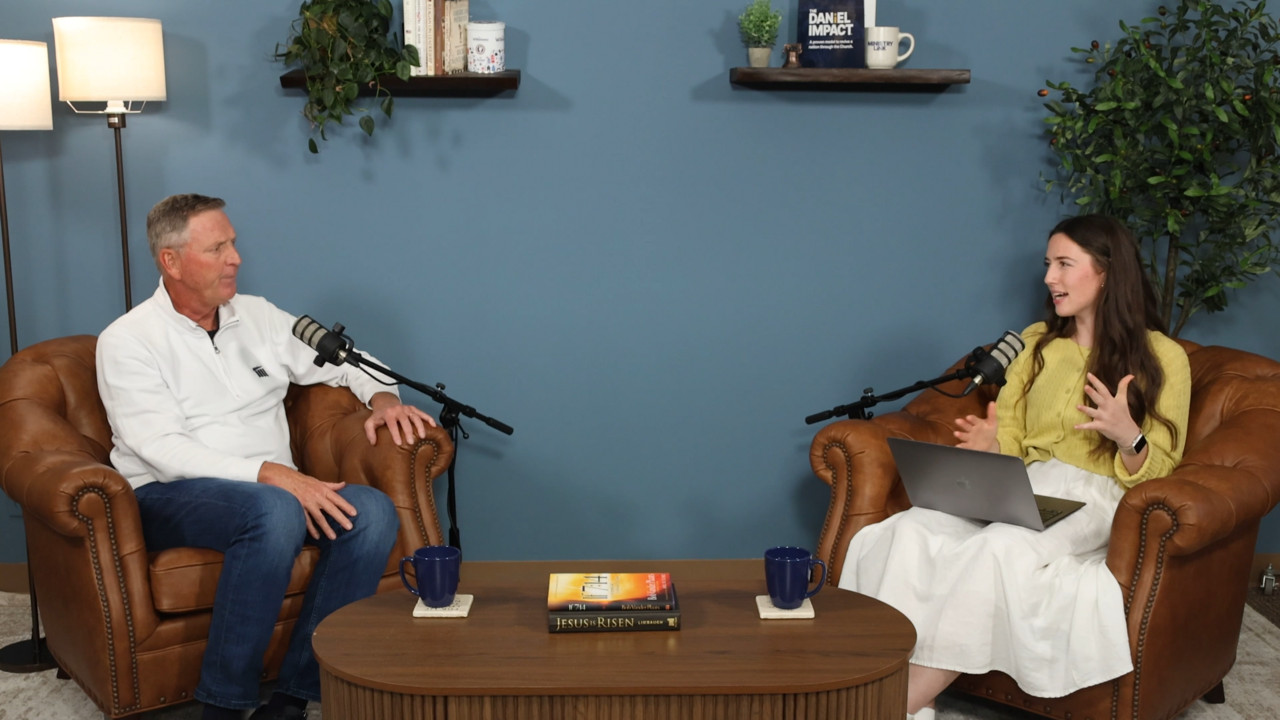
The results of the election are in. The Midterm Elections did not go as hoped. But, there is no time for wallowing. There is much to learn from this. It was political history. Bob and Victoria analyze the midterm elections now that we are over one week out.
What did this election expose about the conservative movement? What needs to change? And how do Christians think about long-term cultural influence rather than just winning elections? Basically we need to ask “where do we go from here?”
Episode Transcript
Bob: Hey, welcome back to another episode of All In to Win. Even though the election probably didn’t go the way we wanted it to last Tuesday night, we still showed up here today to visit with you because we knew you’d want to have this kind of dialogue. So thank you for tuning in, wherever you’re at.
Today we have a guest you’ve seen before, but I know you’ll welcome her back because she’s really, really good and very, very insightful. We’re going to flip roles today, where she’s going to interview me instead of me interviewing a guest.
So, Victoria Nerem, who’s our Gen Z-er in residence, a Faith Baptist Bible College student and volleyball player, and a TFL team member. We love having her on board.
Victoria, let’s talk.
Victoria: Bob, let’s chat. I feel like I’m just on year two.
Bob: Well, if we pay you to say good stuff, then you’re not a guest. You are a paid contributor.
Victoria: Oh, I love it!
Obviously, like you said, the midterms did not go exactly as we were anticipating. Last week, we had Chuck on, and I loved that conversation. I know you guys loved that conversation, too. It was really insightful. Chuck has such a good grasp on everything because of how well-connected he is, especially in Iowa. I really appreciated that episode.
For this episode, though, since you were doing more of the talking to Chuck and Chuck was doing the analyzing, I want to talk to you and have you do some of the analyzing.
Bob: Something we should get Chuck back in?
Victoria: No, he would be really, really good.
Okay, so I titled this episode, “What Did We Learn, and Where Do We Go From Here?” We know the results. Everyone knows the results. You can look up the different Senate seats and races. They’re all called at this point. But we want to talk about what we need to learn and how we’re going to move on, because if we don’t do those two things, then it’s just going to be a broken record over and over again.
You’ve had some days to process the midterm results, and you had a post on X that I really liked where you called it a blue tsunami and highlighted three of your key takeaways: independent voters sending a message to President Trump, the personal impact of the economy, and then having a bigger, wider field of candidates in 2028.
Now that you’ve had some time to reflect, what do you believe this election revealed about the direction of our country? What stands out to you that we need to pay attention to, not just as Republicans, but as Americans?
Bob: You’ll probably go a little bit deeper today, Victoria, than what I did on the tweet.
Really, in reflection, after having a team meeting today, I believe what the election showcased is that we’re a very unstable people. We’re a very anxious people. And we’re not just constitutionally illiterate, but biblically illiterate as well.
I look back at 2024 and the election after that, when Trump won with basically a mandate from the American people. He got 330 or whatever Electoral College votes. The narrative from the mainstream media was, “Can Democrats win again? Are they just too far gone? Are they governed by the crazies of their party? Can they ever, ever win again?”
Then 2026 came, and this blue tsunami came. As a matter of fact, I remember when the New York Times poll came out right before the election. I even told Steve Deace, “Bookmark this poll, because they are so off track. There is no way it’s going to be like that.”
And it wasn’t. It was worse. That’s where the blue tsunami came from.
You get a blue tsunami in the state of Texas. Nobody saw that every statewide race would be gone. The chief justice, the agriculture candidate, the secretary candidate, Greg Abbott, Ken Paxton, the lieutenant governor—there are a lot of people who aren’t talking about that. Ken Paxton’s gone. And then obviously Ken Paxton didn’t win. Who am I thinking of? Who did Talarico beat? Ken Paxton. But Dan Patrick, the lieutenant governor, is gone. Ken Paxton and Dan Patrick—they’re both gone, regardless.
And in Iowa, the same way. We lost the governorship. Begich lost the U.S. Senate race. Begich lost three of the four congressional races. That’s pretty big for the state of Iowa, and we’re more and more of a red state today.
I just see it as we’re anxious and unstable. I think every time the average voter went to the gas pump and put $4-plus a gallon into the gas tank, it reminded them that things are not on the right track. So they’re sending a message. The message was to Washington, D.C., and President Trump specifically.
But at the same time, they didn’t go flat-out crazy. This blue tsunami had some silver linings.
The state of Washington voted to save girls’ sports. Now, that would be a no-brainer in the state of Iowa, South Dakota, or North Dakota. But this was the state of Washington saying, “Men don’t belong in women’s sports.”
In the state of Iowa, when you elected a Democrat governor, a Democrat U.S. senator, and Democrat congresspeople, people also voted in an income tax amendment where you can’t raise the income tax. Those are big conservative deals that happened all over the country.
In Iowa, you kept a Republican legislature. You voted in three statewide races. So not all was lost.
That’s what I told Darla on our ride to Columbus, Ohio, to visit our fourth grandbaby. I said to Darla, “I don’t think the voter is as dumb as sometimes we project them to be,” because they showed in this election that they could walk and chew gum at the same time.
Victoria: Yep, I agree.
I want to talk about both of those things: the electorate sending the president a message and gas prices. We’re going to get to that. But something you mentioned was that, as you were reflecting, one of your takeaways was that you feel like our country is more biblically illiterate.
Tell me how that played into this election specifically.
Bob: Well, when you’re biblically illiterate, you get swayed quickly. People like James Talarico in Texas can use Scripture, and you’re like, “That sounds good. He believes just like I do, so I’m going to go with him.”
Or Rob Sand can use Scripture, and you go, “Wow, that sounds like something I heard in my church one time. I’m going to go with him.”
You need to take the gospel and the Word of God in all of its fullness and richness. You don’t add a word to it, nor do you take a word away from it. So we need to get more biblically sound as a people.
Victoria: Something that a lot of people have been talking about is the quality of candidates. We can go back and forth and debate whether that was a factor in this election or not.
But I think the main problem for the church, at least how I’m viewing it as I’m reflecting, was that we had candidates from the Democratic Party who seemed Christian but don’t have Christian policies. Then we put up some candidates, maybe like in Texas, who don’t act like Christians, but their policies are Christian.
I think the average voter, not necessarily the church, just had a hard time distinguishing the difference between those two things.
Bob: You’re exactly right. And when you have a hard time distinguishing between the two, your emotions take over.
A lot of the emotions of the people in this country, if we’re just being transparent and honest, were that they were ticked off and wanted somebody to blame.
When President Trump would say, “Vote like I’m on the ballot,” a little bit of me was like, “No, no, no, no. Don’t do that.”
Because everything you want to defeat needs a face. It needs a boogeyman, so to speak. And Trump, because of his larger-than-life personality, which in a lot of ways is good, becomes an easy target as well.
I think that all played into this blue tsunami. I think it was a message election. It was not a reset election.
Victoria: Yep. Let’s talk about that, then.
One of the interesting findings from the AP voter poll was that four out of 10 voters said their vote for Congress was intended to express opposition to President Trump. Fewer than two in 10 said they were voting to express support for him, while four in 10 said he wasn’t a factor.
So even though Trump wasn’t on the ballot, he was clearly part of the conversation.
How should we interpret that? Does this election reveal the danger of building too much of a political movement around one personality? And how important is it for the Republican Party to reestablish a vision and identity that can stand on its own?
Bob: It’s a great question. The issue with politics is that it’s quickly attached to a person. You have a personality, again, like we said, that’s larger than life: President Trump.
He also plays big into the voters. I mean, 60% said he played a factor. Forty percent said, “I’m voting against him,” and 20% said, “I’m voting for him.”
Okay, those aren’t good odds. But I think the vision has got to be: What do you want to vote for, not what do you want to vote against?
If I’m the conservative movement today, you have to cast a vision of voting for something.
I was having a conversation with one of my nephews, and I had a long ride home by myself from Columbus. Darla stayed with the baby. We were talking, and he asked, “What do you think’s going on?” because he could sense the instability.
I said, “Our God is a God of order. He’s not a God of chaos, and He’s not a God of division. He’s got a unity around order—His order. So the further we remove ourselves from Him, the more chaos you’re going to get, the more division you’re going to get, and the more instability you’re going to get.”
He was like, “Gosh, that’s so simple.”
I said, “But it also tells you how much spiritual warfare we’re encountering. Because if it’s so simple, we just turn our hearts back to God, His principles and precepts, and say, ‘Listen, it’s about Him. It’s not about me,’ right?”
But the spiritual warfare component is coming in, and it’s twisting God’s Word. It’s taking God’s Word out of context, and it’s starting to be like the whole Garden of Eden: “Live for yourself. Don’t live for God.”
Victoria: Yeah, that’s good.
I liked how you said something about what we learned specifically from Trump’s role in this election. There were a lot of people voting against something and not a lot of people voting for something.
I want to talk about both of those. First, I want to talk about what people were voting against—the issues behind the votes.
You mentioned in your post that politics is personal: gas prices, inflation, and cost of living. We know this was a huge issue for voters. A lot of people went out to the polls just to show President Trump, “I’m mad about the economy,” because it’s affecting their daily lives.
It seems like voters were expressing frustration on several different fronts. Do you think Republicans underestimated what was weighing on everyday Americans? And what does that tell us about the difference between talking about political accomplishments and helping people see how those accomplishments affect their lives?
There was certain messaging in deep-red states that I heard where people were expressing their concerns about the cost of living, saying, “We can’t afford gas. We can’t afford ground beef.”
Then the messages back to them in political ads or speeches were saying, “Well, pick a different protein than ground beef.”
How do you think Republicans underestimated the weight of the cost of living?
Bob: Well, I think you’re starting to see it in the aftermath. I think you’re seeing Ron DeSantis say it. I think you’re seeing Ted Cruz say it. I think even President Trump said it a little bit in his 60 Minutes interview.
The message matters.
People still personalize their politics. When you’re sitting around the kitchen table and you’re saying, “Holy cow, I stopped to fill up the gas today, and it cost me $100. And I don’t have a big tank,” or, “I went to the grocery store today, and I can’t believe what ground beef, much less steak, costs.”
People who never knew what Spam was before are buying it, and Spam sales are through the roof right now.
That was personalized. Therefore, there’s financial insecurity and instability.
But then there’s also the messaging on the Iran war. “Okay, why are we there? You said it was going to be done within a couple of weeks, and then six weeks, and then a couple of months. What are we still doing there? Why are we negotiating with somebody that wants to kill us? They want to nuke us off the planet, and they want to nuke Israel off the planet.”
So there’s the messaging on the war and the messaging on the economy.
I used to be a teacher, and the old teacher axiom is, “Kids don’t care how much you know until they know how much you care.”
Even the messaging when the media would ask President Trump, “Are you concerned about the cost of living for Americans?” and he would say, “No, I’m not concerned about that. I’m worried about the—”
No, no, no. You are concerned about that. And it is a price to pay because of the war that we’re fighting in Iran. But remind people why it’s worth it in the short term so we get long-term stability, both financially and with national security.
Victoria: Yeah, I just think that the messaging wasn’t hitting people right, because different people in charge were saying one thing, but our pocketbooks were kind of saying something else.
Bob: And then there’s also the thing that we’ll look at the stock market. Well, there’s a lot of people not in the stock market. Look at your 401(k)s. A lot of people don’t look at their 401(k)s. So all that stuff is inconsequential to me right now. I want to know how much money I have coming in and how far it will go every pay period.
Victoria: I think Americans in this election cycle showed we want stability. We want the financial compensation to match what we’re paying out. And I think we just realized kind of where Americans were at.
Bob: And you’ll probably go here, Victoria, so I don’t mean to jump ahead, but the one thing that disturbed me is that a lot of our people, our base, the church, showed up. A lot of Trump’s people, the MAGA people, showed up. A lot of the GOP people showed up, and they joined the chorus in sending a message.
And when it comes to our people, I’m like, okay, I get it. Politics is personal. The kitchen table is real. But there’s still some moral conviction issues here. These are ministers of God.
The cornerstone has got to be the sanctity of human life, religious liberty, and the best environment we have for families. And yet you voted against that.
Victoria: And for that, to me, we need to do a better job in educating and communicating our message. That’s a good point, and we will definitely get kind of into where the church is at with that.
But now that we’ve talked about what people were voting against and that they didn’t have something to vote for, I want to look kind of into the future for the next generation and for the future of conservatism.
Another finding that stands out is the shift among young voters. One of the polls that I read said that seven in 10 voters under the age of 30 supported a Democratic candidate for the U.S. House. That’s a significant change from what it was in 2024, when Trump was getting a hold of young men by speaking a message they wanted to hear about corruption, not having another war, and finances. He really got a hold of that voting bloc, and those were the people who showed up to vote for him in 2024.
Now I saw those same people got out to vote in 2026, but they did not vote for President Trump.
What do you think is happening with the younger generation? Why do you think young voters specifically moved to vote for Democrats in this election? And how do you see the conservative movement moving forward?
Bob: There are a couple of thoughts, but let me begin with the adage: You can fool a fool, you can con a con, but you cannot kid a kid.
Kids are looking for authenticity.
Think about it. Just over a year ago, we had the memorial service for Charlie Kirk, and Charlie Kirk was all about galvanizing the youth. After Charlie Kirk’s senseless assassination, you would have thought the youth would have risen up in droves to honor Charlie and make sure we didn’t get what we got Tuesday night.
However you look at it, the message in 2024 was, “No more senseless foreign wars. We’re going to get inflation down. We’re going to get gas prices down. We’re going to get the cost of living down. You’re going to be able to afford your home. You’re going to be able to do all that.”
That was a winning message.
And yet they look around and go, “No, no, no. We’re in a war. Inflation is up. Interest rates are up. Cost of living is up. I can’t afford a home. Corruption seems to be on the rise. I didn’t vote for that, so I’m going to send a message. I’m voting the other way.”
Even if they don’t agree with the other way, they’re going to send a message: “You didn’t deliver. I’m going to vote this way.”
Victoria: Yeah. So how do you think we can regain that generation now?
Bob: I think we need to do what Ron DeSantis, Ted Cruz, and others I’ve listened to afterward have been saying: cast a vision.
You have to personalize politics. How are we making a difference in your daily life?
Ronald Reagan—you’re way too young to remember even Ronald Reagan—but he summed it up really well when he was running against Jimmy Carter. He said, “Listen, if you’re better off than you were four years ago, then vote for my opponent. But if you’re not better off than you were four years ago, vote for me.”
He took it and encapsulated it in a very short sound bite, but it was a determining factor.
Frankly, that’s what a lot of people are looking at. Do I feel safer? Am I more prosperous? Can I get the American Dream that my parents and everybody else have cast the vision for? Can I get married and my husband—you, not me, obviously—you and your husband, and your family, can you have the American Dream?
Can I have a day where I have it better than my parents? My parents’ generation would all raise their hands when asked, “How many of your kids have it better than you?”
There’s a lot in my generation that’s saying, “How many of your kids will have it better than you?” There are a lot of us probably not raising our hands.
And we want that for our kids. We want you to have it better than we had it.
Victoria: Yeah. So I just think we need a stronger message going into the future.
Maybe it’s not necessarily just young people, but the conservative movement in general. People are saying, “We’ve gone so blue. There’s no way we could ever come back from that.”
There are a lot of Americans who aren’t particularly enthusiastic about the GOP in general. There are a lot of different factions going on within it.
Is there an opportunity here for conservatives to rebuild trust with people who are dissatisfied with both political parties? And what do Republicans need to be honest about? How do we distinguish between a messaging problem and a problem with leadership?
Bob: Yes, and yes.
First of all, what I’d say is that both parties have taken a hit. We even saw Rob Sand, who ran for governor in Iowa, run against the Democratic Party and the Republican Party. It was kind of like, “This binary system’s got to go.”
That provides a real opportunity for a ministry like The Family Leader. Why are you voting? What’s the biblical foundation? Not just a conservative foundation, but what’s the biblical foundation? And then what’s the conservative constitutional foundation on top of that?
How do you raise up candidates who can be effective messengers and leaders who can deliver on the message they give?
And be honest with the American people. If we’re not going to be out of a war anytime soon, but it’s worth the cause, remind them: What is the cause? What are we doing? What are we fighting for? Why should Iran have a nuclear weapon? Why are we all in this together?
It all gets back to messaging as well, but you have to deliver results. If you deliver results, you’ll get the trust. If you get the trust, you’ll get the victory.
That said, the other opportunity comes because of how unstable we are. We’re anxious because we don’t have these firm foundations.
I went right off any election at any time. The voter right now has proven, “I’m very fickle.” And I’m very fickle because I’m being tossed about in the winds and the waves because I’m not anchored.
Our job is to get the voter anchored in biblical principles and philosophy and conservative tradition. That should be our goal in moving the culture forward.
Victoria: Which is what The Family Leader does, right?
So what is the biggest lesson for us personally, like The Family Leader and the broader Christian community? What can we be doing over these next two years to be diligent, faithful, and engaged, even though we’re not necessarily the ones holding political power?
Bob: You know, it’s easy to put everything onto the church, right onto the pastors. However, I think it’s got to be a wake-up call for the church as well.
Listen, there’s probably a lot of people in my congregation who are biblically illiterate. What are we doing to challenge our membership to get into the Word, to be in prayer, and to have classes on major topical discussions and the biblical principles that apply to them?
There are a lot of things we can do at The Family Leader. We want to do that. We want to equip and send.
Equip pastors, send pastors. Equip officeholders, send officeholders. Equip candidates, send candidates. Equip youth, send youth.
It’s all about equipping and sending.
But I think the huge focus for us at The Family Leader now, and I also believe for the body of Christ as a whole, is equip, equip, equip.
Victoria: Yep, we got to do that.
Moving into this next one, I liked how you said at the very end of your tweet, “Learn, yes. Diligent, always.”
Bob: What’s interesting is that this comes out of the Scriptures, where it says the diligent will rule. And what you notice about that—Chuck Hurley brings this up really well—is that the diligent will rule. It doesn’t say the godly will rule, and it doesn’t say the ungodly will rule. It says the diligent will rule.
So our job as believers is to be more and more diligent.
Victoria: That’s great. That’s a really great way to say it. And as Christians, we should be diligent. Amen. As the church, we should be diligent.
I’m excited and energized to think about 2028, learn, and then be diligent moving forward.
Where exactly do we go from here? As we’re talking about what we want to change and the things we want to do, what do you think people can practically look at over the next two years, until the presidential cycle?
What can we do? What is our future? Should we just wallow and say, “We lost. There’s no chance of anything happening ever”?
Bob: Oh, absolutely not. I think now’s the time to double down. Now’s the time to say, “Listen, all is not lost. We’re called for such a time as this.”
For us at the ministry, we are more committed to our four-I model than ever. The reason we’re committed to it is because it’s biblical.
We are going to inspire the church. We are going to impact elections. We are going to influence policy. And we are going to enact biblical partnership.
We believe if you do that, you can win the next election and win the next generation.
That’s from the church side and the ministry side.
Practically, when it comes to the Donald Trump side, we need him to be successful. The reason I say we need him to be successful is that if his approval rating stays under 30%, it probably doesn’t matter who you nominate in 2028. You’re going to get the Barack Obama of 2006. In 2008, you got Obama.
So if he’s successful, you have a shot to win back the presidency.
I think there need to be some real conversations within the Trump orbit and through the legislature, the House and Senate, and governorships. How do we make him successful?
Victoria: That’s good. That’s a good point. Because we don’t want it to end kind of like the Bush-to-Obama transition.
We need Trump—which, I mean, Donald Trump is a political figure we probably haven’t seen before in American history.
Bob: The big thing here, I think, is that with Trump, what we see is that it can’t be a constant fight. We need to be able to agree on stuff that we can agree on. Don’t sell your values or your principles, but agree where you can agree. Let’s move America forward.
Let’s end that Iran war successfully. You have to win it now. Pull out of it. You have to win it, then be done with it and move on. And then try to get these prices back down.
I think you have a shot.
Victoria: Yep, I agree. Okay, so you ended your post by saying, “As Christians, we don’t respond like those without hope. God remains on the throne.”
I think that’s an important reminder. It was a good reminder for me. I needed to hear it this week.
Especially when people are discouraged by the direction of the country, how can truth shape our response to this election? How can we know that we’re still Christians, and that our home is not here on earth, while still being engaged?
Bob: Be in the Word. Be refreshed. Be cleansed.
I got to tell you, I did not feel like going to church Sunday after driving back from Columbus, Ohio. It was a late night, and I thought to myself, “I need to be in church.”
A, for me, I need to be in church. But I also think my family of church members need to see me there and be reminded that we do not mourn like those who have no hope.
We need to have a smile on our face. We need to have a bounce in our step. That’s because we do look higher. Our help comes from the Lord, not from elections.
You know, “Get behind me, Satan.” Look at the eternal, not the earthly.
And you know what? God’s not done with us yet. He’s not done with this country yet. So game on!
Victoria: I love it. I love it.
All right, Bob. Well, that is kind of our take on the midterm elections as we continue to deal with the fallout from them.
We’re going to keep covering it on this podcast. We want this to continue to be an equipping resource for you, something you’re able to share with your friends who are less politically engaged.
Everyone has 25 minutes in a week. They can tune in, be equipped, and learn some more things, and always remember to be all in to win.
Bob: You know, the coach in me says it’s okay to lose. It’s not okay not to learn. You have to learn from your loss.
Victoria: So don’t just move on from the loss. Go ahead and lament the loss. But then ask yourself: What did you learn, and how do you move forward?
That’s what we’re going to do here. That’s what we hope you do.
We are all in to win. We’re not going to let our testimony get disqualified for the prize.
And we need you to share this with your friends. Leave a five-star review, and until next time, stay diligent and let you and your family be all in to win.